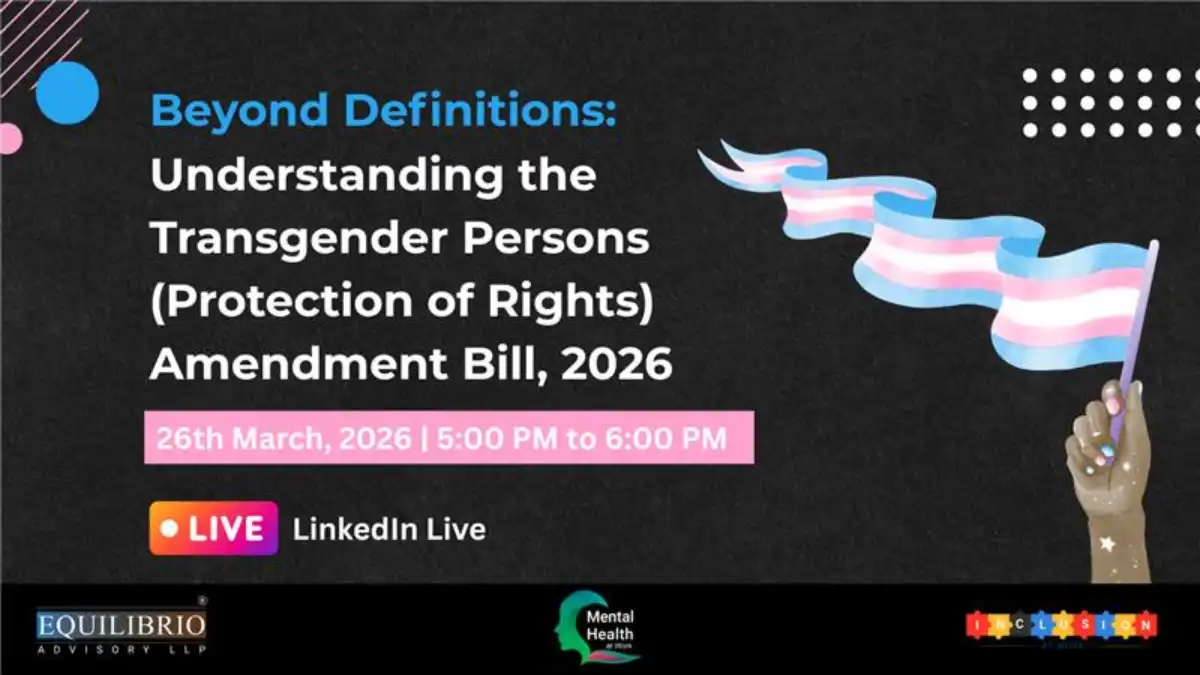
The Transgender Persons (Protection of Rights) Amendment Act, 2026 marks a significant shift in India’s legal framework on transgender rights. The amendment has already been notified and brought into force, introducing substantial changes to the earlier regime under the 2019 Act.
One of the most notable changes is the removal of the principle of self-perceived gender identity, which was previously recognised under law and rooted in the Supreme Court’s decision in NALSA v. Union of India (2014). The amended framework introduces a certification-based recognition mechanism, altering how legal identity is determined.
These changes have triggered legal debate and have direct implications for organisations, particularly in relation to documentation, workplace inclusion, and policy alignment.

Duration: 1 Hour
Mode: Virtual
Special Access: Complimentary for Trans Persons
Facilitators: Adv. Vamsi Mohana and Adv. Shambhavi Rai
Detail Description
Areas Covered
Legal Evolution & Context
- NALSA v. Union of India (2014)
- Framework under the 2019 Act
- Why the 2026 Amendment was introduced
Changes Under the Amendment Act, 2026
- Removal of self-identification as a legal basis for gender recognition
- Introduction of medical screening-based certification mechanisms
- Redefinition and narrowing of “transgender person”
- Changes impacting existing identity certificates and recognition processes
- Introduction of new offences and penalties, and possible implications on access to community support and access to healthcare
Legal & Workplace Implications
- Impact on HR records, employee identity documentation, and onboarding
- Challenges in aligning DEI policies with evolving law
- Risk of conflict with constitutional jurisprudence (NALSA principles)
- Handling sensitive workplace situations and complaints
Resources & Support Framework
- Government processes for identity certification
- Welfare schemes and access mechanisms
- Practical steps organisations can take to support trans employees