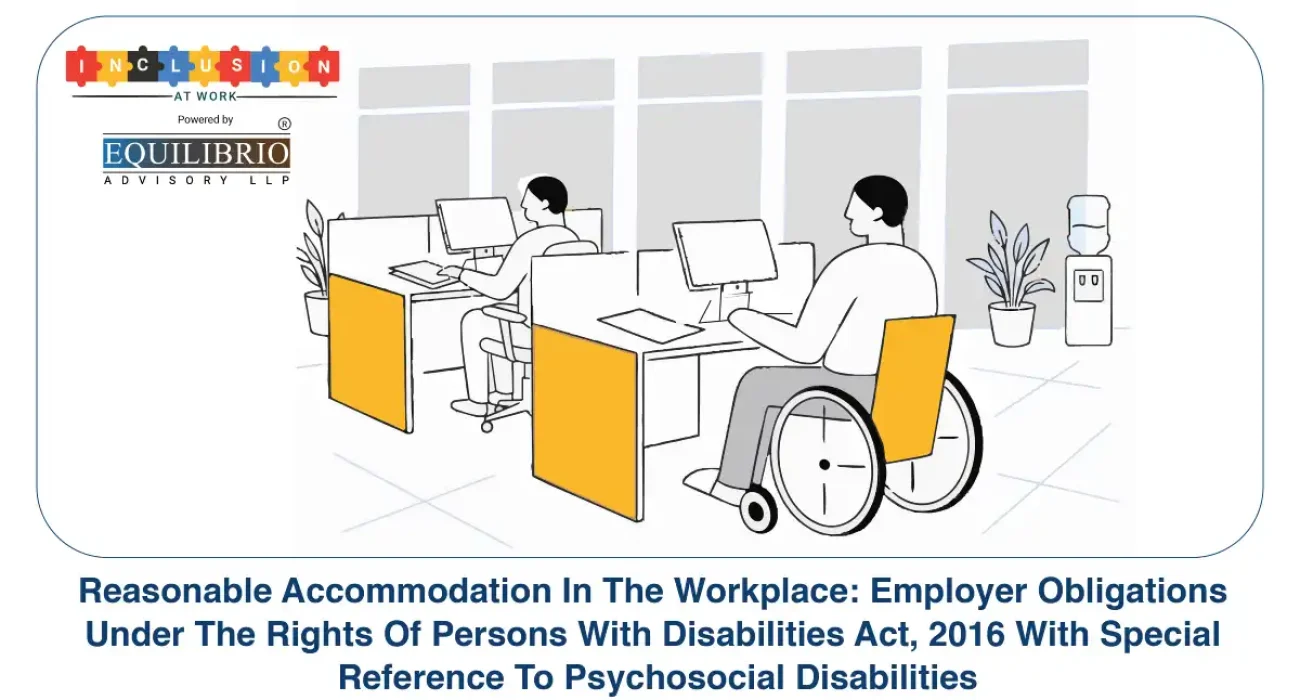
Reasonable Accommodation In The Workplace: Employer Obligations Under The Rights Of Persons With Disabilities Act, 2016 With Special Reference To Psychosocial Disabilities
Mental health has emerged as one of the defining workplace issues of the modern era. Organisations are increasingly witnessing employees seeking support for conditions such as depression, anxiety disorders, bipolar disorder and schizophrenia. While many employers have responded by introducing wellness initiatives and employee assistance programmes, compliance with Indian disability law requires considerably more than promoting mental well-being. It requires employers to recognise that, in appropriate cases, employees with psychosocial disabilities are entitled to reasonable accommodation as a matter of legal right.
The obligation to provide reasonable accommodation is contained in the Rights of Persons with Disabilities Act, 2016 (“RPwD Act”), which was enacted to give effect to India’s obligations under the United Nations Convention on the Rights of Persons with Disabilities (UNCRPD). The Act marks a significant departure from a welfare-based approach to disability by recognising that equality cannot always be achieved by treating everyone identically. Instead, where workplace practices create barriers for persons with disabilities, employers may be required to make necessary and appropriate modifications to enable their effective participation.
This obligation assumes particular significance in the context of psychosocial disabilities. Unlike physical disabilities, workplace barriers are often organisational rather than architectural. A rigid attendance policy, inflexible work schedules, inaccessible communication methods or performance management processes may disproportionately disadvantage an employee with a psychosocial disability despite the individual being fully capable of performing the essential functions of the role with appropriate support.
This article examines the legal framework governing reasonable accommodation under the RPwD Act, explains its relationship with the Mental Healthcare Act, 2017 (“MHCA”), and discusses the practical obligations of employers when responding to accommodation requests involving psychosocial disabilities.
Reasonable Accommodation: A Legal Obligation
Reasonable accommodation is frequently misunderstood as a discretionary concession or an act of goodwill extended by an employer. The RPwD Act adopts a fundamentally different approach. It treats reasonable accommodation as an essential component of equality.
Section 2(y) of the RPwD Act defines reasonable accommodation as the necessary and appropriate modifications and adjustments, without imposing a disproportionate or undue burden, to ensure that persons with disabilities enjoy or exercise their rights equally with others. The emphasis is therefore not on preferential treatment but on removing barriers that prevent equal participation.
The concept is rooted in the principle of substantive equality. Treating every employee in exactly the same manner may appear neutral, but identical treatment can produce unequal outcomes where workplace systems are designed without considering disability-related needs. A fixed reporting time, mandatory in-person meetings or uniform productivity targets may disproportionately affect employees with certain disabilities. In such circumstances, equality may require modification rather than uniformity.
The Supreme Court has affirmed this approach in Vikash Kumar v. Union Public Service Commission, holding that reasonable accommodation is intrinsic to substantive equality and requires institutions to adopt an individualised assessment rather than rigidly applying uniform standards. The Court recognised that the denial of reasonable accommodation may itself amount to discrimination because it prevents persons with disabilities from participating on an equal basis with others.
For employers, this shifts the inquiry from whether an exception should be granted to whether an existing workplace barrier can reasonably be removed without imposing a disproportionate burden on the organisation.
Psychosocial Disabilities and the Legal Framework
The RPwD Act expressly recognises mental illness as a specified disability. The expression derives its meaning from the Mental Healthcare Act, 2017, thereby ensuring consistency between the two statutes.
Although both enactments concern persons living with mental illness, they perform different functions. The MHCA safeguards rights relating to mental healthcare, including access to treatment, confidentiality, informed consent and dignity. The RPwD Act, on the other hand, addresses equality, non-discrimination and participation in areas such as employment, education and public life. Together, they create a complementary legal framework.
For employers, this distinction is important. The obligation to consider workplace adjustments flows from the RPwD Act. However, the manner in which medical information is obtained, stored and disclosed must also respect the confidentiality protections recognised under the MHCA. An employer responding to an accommodation request should therefore focus on the employee’s functional limitations and workplace requirements rather than seeking unnecessary details of the employee’s diagnosis or treatment.
Importantly, accommodation is not determined solely by the existence of a medical condition. Two employees with the same diagnosis may require entirely different workplace adjustments, while employees with different conditions may benefit from identical accommodations. The assessment should therefore remain functional, individualised and role-specific.
Employer Obligations under the RPwD Act
The RPwD Act imposes both negative and positive obligations upon employers.
Non-Discrimination
Reasonable Accommodation
Equal Opportunity Policy
Confidentiality
First, employers must ensure that persons with disabilities are not discriminated against in matters relating to recruitment, promotion, training, transfer, performance evaluation or termination. The obligation extends throughout the employment relationship and requires employers to assess employees based on their ability to perform the essential functions of the role with reasonable accommodation where necessary.
Secondly, employers are required to provide reasonable accommodation unless doing so would impose a disproportionate or undue burden. This requires an individual assessment of the employee’s needs, the nature of the role and the feasibility of the proposed adjustment. Blanket policies refusing flexible work arrangements or limiting accommodation to particular categories of disabilities are unlikely to satisfy this obligation.
The RPwD Act also requires notified establishments to publish an Equal Opportunity Policy. While often viewed as a compliance requirement, such policies should ideally establish a clear process for requesting accommodations, identify decision-makers, prescribe timelines and incorporate safeguards relating to confidentiality and grievance redressal.
Confidentiality assumes particular significance where accommodation requests relate to psychosocial disabilities. Supervisors ordinarily require information regarding the accommodation to be implemented rather than the employee’s diagnosis. Medical records should be accessed only by those responsible for assessing the request and handled in accordance with applicable legal and organisational requirements.
What Constitutes Reasonable Accommodation?
Reasonable accommodation is highly contextual. The appropriate adjustment depends upon the employee’s functional limitations, the essential requirements of the role and the operational needs of the organisation. There is no exhaustive list of accommodations under the RPwD Act.
The following examples illustrate common workplace accommodations for psychosocial disabilities:
Workplace area
Illustrative accommodation
Working hours
Flexible reporting times, modified schedules, phased return after medical leave
Leave
Time off for therapy, psychiatric consultations or treatment
Communication
Written instructions, advance meeting agendas, structured feedback
Work environment
Quiet workspace, reduced sensory distractions, hybrid work where appropriate
Performance management
Modified timelines, prioritised work allocation, regular supervisory check-ins
Technology
Task management software, reminder tools, assistive digital applications
Meetings and training
Recorded sessions, written material, additional processing time where appropriate
These measures are illustrative rather than mandatory. The objective is to identify adjustments that enable the employee to perform the essential functions of the role while maintaining operational effectiveness.
Equally important is recognising what reasonable accommodation does not require. Employers are generally not expected to eliminate essential job functions, create entirely new positions, reduce legitimate performance standards or implement measures that would fundamentally alter the nature of the business or impose a disproportionate or undue burden.
Practical Considerations for Employers
Accommodation requests should be approached through an interactive and collaborative process rather than a one-time administrative decision.
As a matter of good practice, employers should:
establish a clear process for requesting reasonable accommodation;
assess the employee’s functional limitations rather than focusing solely on the medical diagnosis;
engage with the employee to explore feasible accommodation options;
document the assessment and reasons supporting the final decision;
maintain confidentiality throughout the process;
periodically review accommodations to determine whether modifications remain appropriate; and
train managers and human resource professionals to identify and respond appropriately to accommodation requests.
A structured approach promotes consistency, reduces legal risk and reinforces an inclusive workplace culture.
Conclusion
Reasonable accommodation is no longer a matter of organisational discretion or corporate goodwill. It is a statutory obligation grounded in the principles of equality and inclusion embodied in the RPwD Act. As awareness of psychosocial disabilities continues to grow, employers must move beyond generic mental health initiatives and develop systems capable of responding to individual accommodation needs in a fair, consistent and legally compliant manner.
Organisations that adopt clear accommodation procedures, respect employee confidentiality and engage constructively with accommodation requests are better positioned not only to comply with the law but also to foster workplaces where persons with disabilities can participate and contribute on an equal basis with others.
FAQs
1. Is reasonable accommodation mandatory under the RPwD Act?
Yes. The RPwD Act requires employers to provide reasonable accommodation to persons with disabilities unless doing so would impose a disproportionate or undue burden on the organisation.
2. Does every employee with a mental health condition qualify for reasonable accommodation?
Not necessarily. The need for accommodation depends on whether the employee’s disability creates workplace barriers and whether reasonable adjustments are required to enable them to perform the essential functions of their role.
3. Can an employer ask for medical documents before granting accommodation?
An employer may seek information that is reasonably necessary to assess the accommodation request. However, requests should be limited to relevant information, and any medical records or personal health information must be handled confidentially.
4. What are some examples of reasonable accommodation for psychosocial disabilities?
Examples include flexible working hours, modified work schedules, time off for treatment, written instructions, quieter workspaces, hybrid work arrangements (where feasible), and temporary adjustments to workload or deadlines.
5. Can an employer refuse a request for reasonable accommodation?
Yes, but only where the proposed accommodation would impose a disproportionate or undue burden or where it would fundamentally alter the essential requirements of the role. Employers should assess each request individually and consider whether alternative accommodations are available before refusing the request.