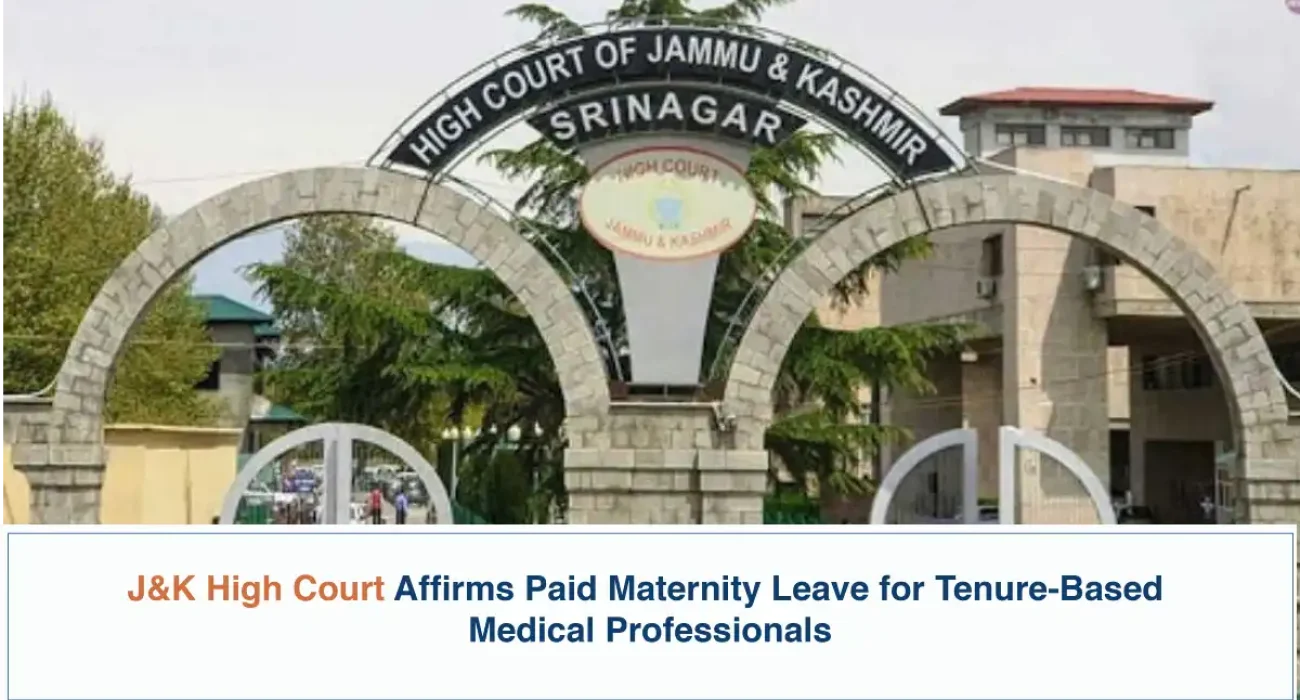
Case Name: Dr. Sonakshi Gupta & Others v. Union Territory of Jammu & Kashmir & Others
Factual Background
The petitioners, who were engaged as Senior Residents/Tutors under the Jammu & Kashmir Medical and Dental Education (Appointment on Academic Arrangement Basis) Rules, 2020, challenged a communication dated 14 October 2025 whereby the respondents denied them pay and allowances during the period of maternity leave. Although Government Order No. 451-JK(HME) of 2024 expressly extended maternity leave, medical termination of pregnancy (MTP), and abortion leave to Senior Residents/Tutors in accordance with Government rules and regulations, the respondents subsequently withheld the petitioners’ salaries on the ground that they were “out of assignment” during the leave period. The petitioners contended that Rule 41(1) of the J&K Civil Services (Leave) Rules, 1979, as amended by SRO 353 of 2015, guaranteed 180 days of maternity leave with full leave salary and that the impugned communication arbitrarily deprived them of a statutory and constitutional entitlement. They further argued that the extension of their residency period was merely an academic adjustment and could not justify withholding salary during maternity leave.
Court’s Analysis
The High Court held that Government Order No. 451-JK(HME) of 2024 unequivocally granted maternity leave to Senior Residents/Tutors in accordance with existing Government rules and regulations, thereby attracting Rule 41(1) of the J&K Civil Services (Leave) Rules, which guarantees maternity leave with full pay. The Court rejected the respondents’ contention that the petitioners’ tenure-based appointments disentitled them from receiving salary during maternity leave. It observed that the respondents could not selectively rely upon the Government Order to grant leave while simultaneously denying the financial benefits that are inseparable from such leave.
Emphasising the constitutional vision of a welfare State, the Court held that motherhood cannot become a ground for economic disadvantage. It relied extensively upon the Division Bench judgment in Jammu and Kashmir Bank Ltd. v. Tanu Gupta, as well as the Supreme Court’s decisions in Municipal Corporation of Delhi v. Female Workers (Muster Roll), Deepika Singh v. PGIMER, Chandigarh, and Kavita Yadav v. State (NCT of Delhi), reiterating that maternity benefits are rooted in Articles 14, 15(3), 21, 38, 39, and 42 of the Constitution and must receive a beneficial interpretation. The Court held that denying salary solely because a woman avails maternity leave amounts to unconstitutional discrimination and undermines the dignity of motherhood.
Order of the Court
The High Court quashed the communication dated 14 October 2025 insofar as it denied pay and allowances to the petitioners during maternity leave. It directed the respondents to grant the petitioners full pay and allowances for the entire period of maternity leave, as well as during the extended period of residency corresponding to the maternity leave availed. The writ petition was accordingly allowed and disposed of.
Key Takeaway
The judgment reaffirms that maternity benefits constitute a constitutional and statutory right that cannot be curtailed merely because a woman is employed on a contractual or tenure-based appointment. Once maternity leave is recognised under applicable service rules or government orders, the corresponding entitlement to full salary and service benefits cannot be denied through executive instructions. The decision strengthens workplace gender equality by ensuring that women are not subjected to financial disadvantage on account of pregnancy or childbirth and reinforces the principle that maternity relief must be interpreted liberally to uphold the dignity of working women.
Written by Adv. K. Sri Hamsa