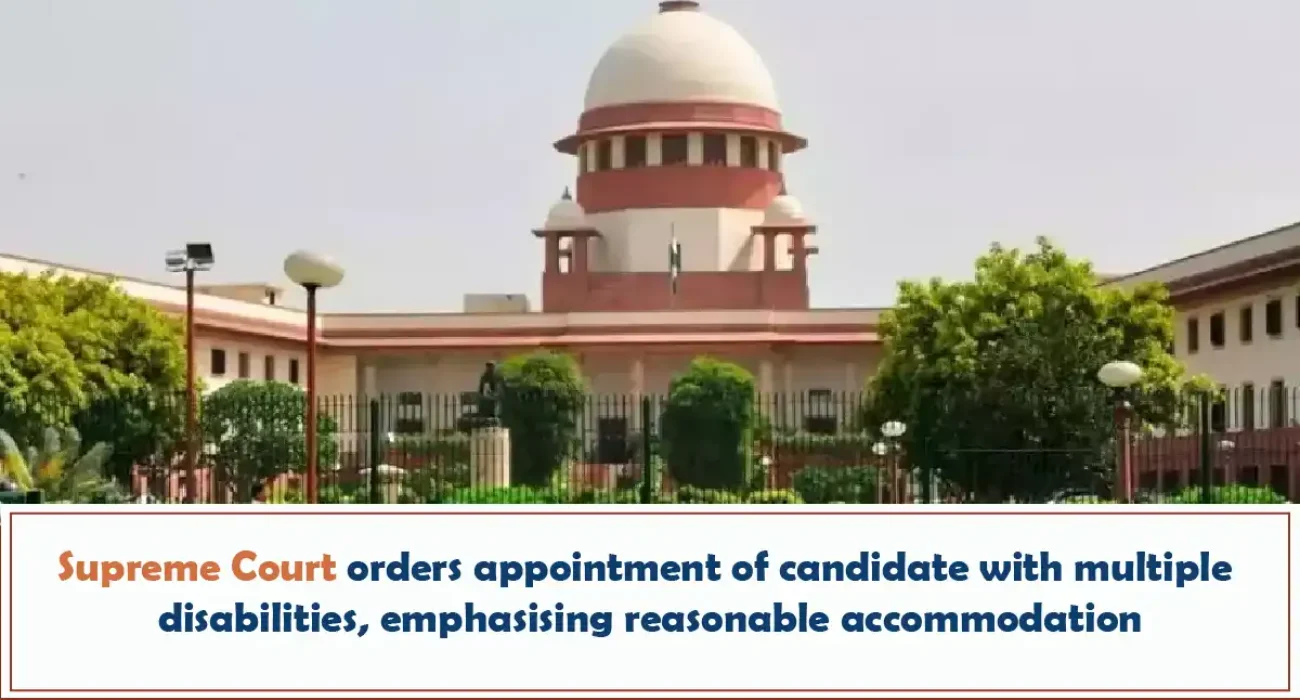
SUJATA BORA v. COAL INDIA LIMITED
Supreme Court of India
Civil Appeal No. 120 of 2026
Citation: 2026 LiveLaw (SC) 46 / 2026 INSC 53
Background and Facts
The appellant, Ms. Sujata Bora, applied for the post of Management Trainee (Personnel & HR) in Coal India Limited pursuant to a recruitment notification issued in 2019. She applied under the category of persons with benchmark disability, having visual impairment, and successfully cleared the selection process, including the interview stage.
At the stage of the Initial Medical Examination conducted in September 2021, the appellant was declared medically unfit on the ground that, in addition to visual impairment, she was also suffering from residual partial hemiparesis. Coal India Limited took the position that the recruitment notification contemplated reservation for candidates with specified disabilities and that the appellant’s additional condition rendered her unsuitable for appointment.
Aggrieved by the declaration of medical unfitness, the appellant approached the Calcutta High Court. The learned Single Judge held that Coal India Limited could not deny appointment to a candidate solely on the ground of multiple disabilities and found the rejection to be contrary to the Rights of Persons with Disabilities Act, 2016. However, relief was limited in view of the recruitment process having concluded. On appeal, the Division Bench reversed the Single Judge’s decision and dismissed the writ petition on the ground that the selection panel had expired.
The appellant thereafter approached the Supreme Court challenging the judgment of the Division Bench and the denial of appointment.
Issues for Consideration
The principal issues before the Supreme Court were whether a candidate with benchmark disability could be denied appointment on the ground of having multiple disabilities not expressly contemplated in the recruitment notification, whether the failure to provide reasonable accommodation amounted to discrimination under the Rights of Persons with Disabilities Act, 2016, and whether technical considerations such as expiry of the recruitment panel could defeat substantive statutory and constitutional rights of persons with disabilities.
Findings and Reasoning
The Supreme Court held that the appellant was a person with benchmark disability within the meaning of the Rights of Persons with Disabilities Act, 2016, with a certified disability of 57%, and was therefore entitled to the protections afforded under the statute. The Court observed that the appellant had been excluded not on the basis of any functional assessment of her ability to discharge the duties of the post, but due to a rigid and mechanical application of the recruitment notification.
The Court reiterated that reasonable accommodation is a central component of disability rights jurisprudence and that denial of reasonable accommodation amounts to discrimination in law. It held that employers, particularly public sector undertakings, are under a statutory obligation to examine whether a person with disability can be accommodated through appropriate adjustments rather than being excluded at the threshold.
The Supreme Court further held that the Division Bench of the High Court erred in denying relief solely on the ground that the recruitment panel had expired. The Court observed that procedural or technical considerations cannot be permitted to override substantive rights, particularly where the exclusion was the result of an unlawful medical disqualification.
The Court emphasised that the Rights of Persons with Disabilities Act, 2016 is a beneficial legislation which must be interpreted in a manner that advances substantive equality in consonance with Articles 14 and 21 of the Constitution.
Decision
Invoking its powers under Article 142 of the Constitution, the Supreme Court set aside the judgment of the Division Bench of the Calcutta High Court and directed Coal India Limited to create a supernumerary post for the appellant. The Court directed that the appellant be appointed to a suitable desk job with necessary assistive facilities and reasonable accommodation. It clarified that the relief was being granted in the peculiar facts and circumstances of the case and should not be treated as a precedent on recruitment norms generally.
The appeal was accordingly allowed.
Adv. Aiswarya Krishnan