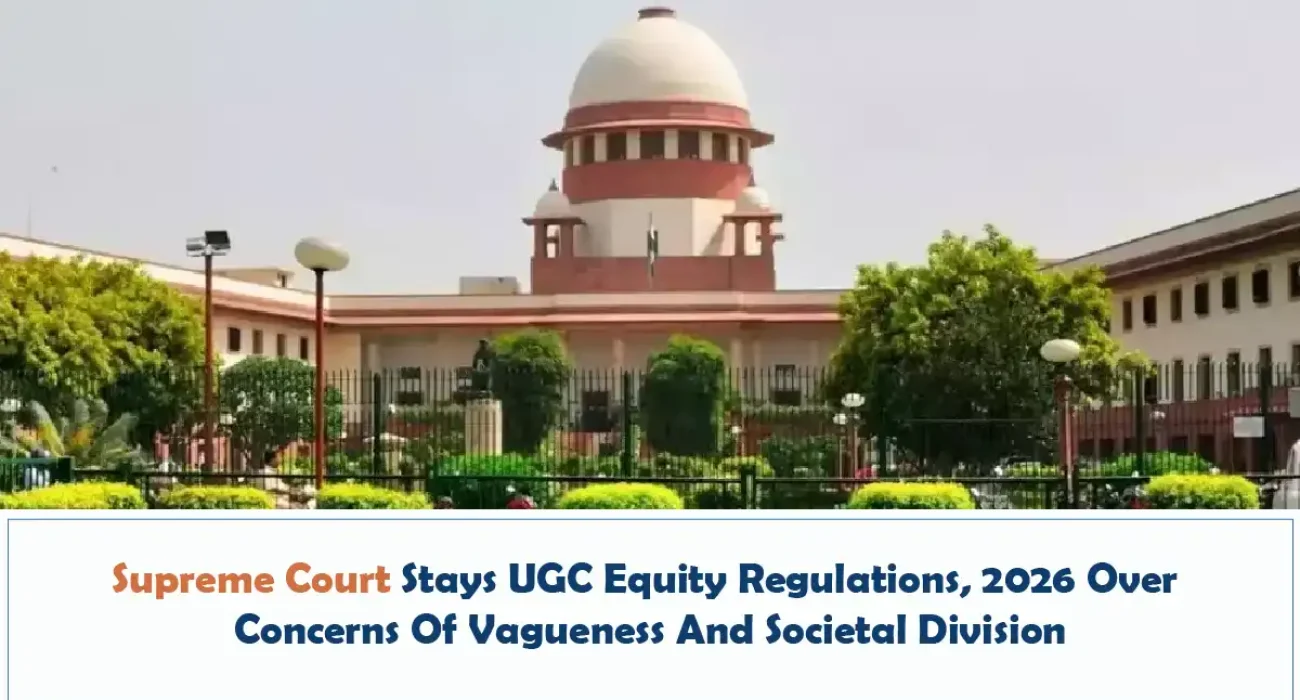
In Re: University Grants Commission (Promotion of Equity in Higher Education Institutions) Regulations, 2026
Supreme Court of India, Order dated 29 January 2026
Background and Facts
The Supreme Court was seized of a batch of petitions challenging the constitutional validity of the University Grants Commission (Promotion of Equity in Higher Education Institutions) Regulations, 2026 (“UGC Equity Regulations, 2026”), notified on 13 January 2026. The Regulations were framed pursuant to earlier directions of the Supreme Court in a public interest litigation seeking stronger mechanisms to address caste-based discrimination in higher educational institutions.
The 2026 Regulations sought to replace the existing UGC (Promotion of Equity in Higher Educational Institutions) Regulations, 2012 and introduced an expanded framework for identifying, preventing and redressing caste-based discrimination, including the constitution of equity committees and definition of prohibited conduct.
The petitioners contended that several provisions of the new Regulations were vague, overbroad and constitutionally infirm, and that the framework, instead of promoting equity, risked deepening social divisions within educational institutions.
Issues for Consideration
The principal issues before the Court were:
- Whether the definitions and scope of “caste-based discrimination” under the UGC Equity Regulations, 2026 were impermissibly vague and prone to misuse;
- Whether limiting the protective framework primarily to Scheduled Castes, Scheduled Tribes and Other Backward Classes raised concerns under Article 14 of the Constitution;
- Whether the Regulations, in their present form, could have unintended and adverse societal consequences; and
- Whether interim protection was required pending final adjudication.
Findings and Reasoning
A Bench of the Supreme Court, while considering the challenge at the interim stage, expressed serious reservations regarding the breadth and ambiguity of the 2026 Regulations. The Court observed that several provisions appeared prima facie capable of wide and subjective interpretation, potentially leading to arbitrary application.
The Court noted that the definition of caste-based discrimination, as framed, restricted its scope to specified categories, thereby excluding students outside those categories from its protective ambit. This, the Court observed, raised concerns of differential treatment and could lead to perceptions of reverse discrimination.
Significantly, the Court cautioned that regulatory frameworks dealing with deeply sensitive social identities must be drafted with precision and balance. It remarked that measures intended to promote equity should not inadvertently deepen fault lines or foster division, observing that such regulations could have a “very dangerous impact” and may “divide society” if not carefully calibrated.
The Bench also questioned the absence of any express reference to ragging and other forms of harassment within the regulatory framework, noting that higher educational institutions are already governed by multiple overlapping regulatory regimes and that coherence is essential.
Emphasising that educational institutions must reflect the unity and inclusiveness of the nation, the Court underscored the need to harmonise anti-discrimination objectives with constitutional values of equality, fairness and social cohesion.
Decision
In view of the above, the Supreme Court stayed the operation of the UGC (Promotion of Equity in Higher Education Institutions) Regulations, 2026 until further orders.
Invoking its powers to ensure continuity of safeguards, the Court directed that the UGC Equity Regulations, 2012 shall continue to operate in the interim so that students are not left without any remedial mechanism against discrimination.
The Court issued notice to the University Grants Commission and the Union Ministry of Education and indicated that the matter would be examined in detail at a later stage, including the possibility of revisiting the regulatory framework to address constitutional and societal concerns.
Written by Adv. Aiswarya Krishnan