Introduction
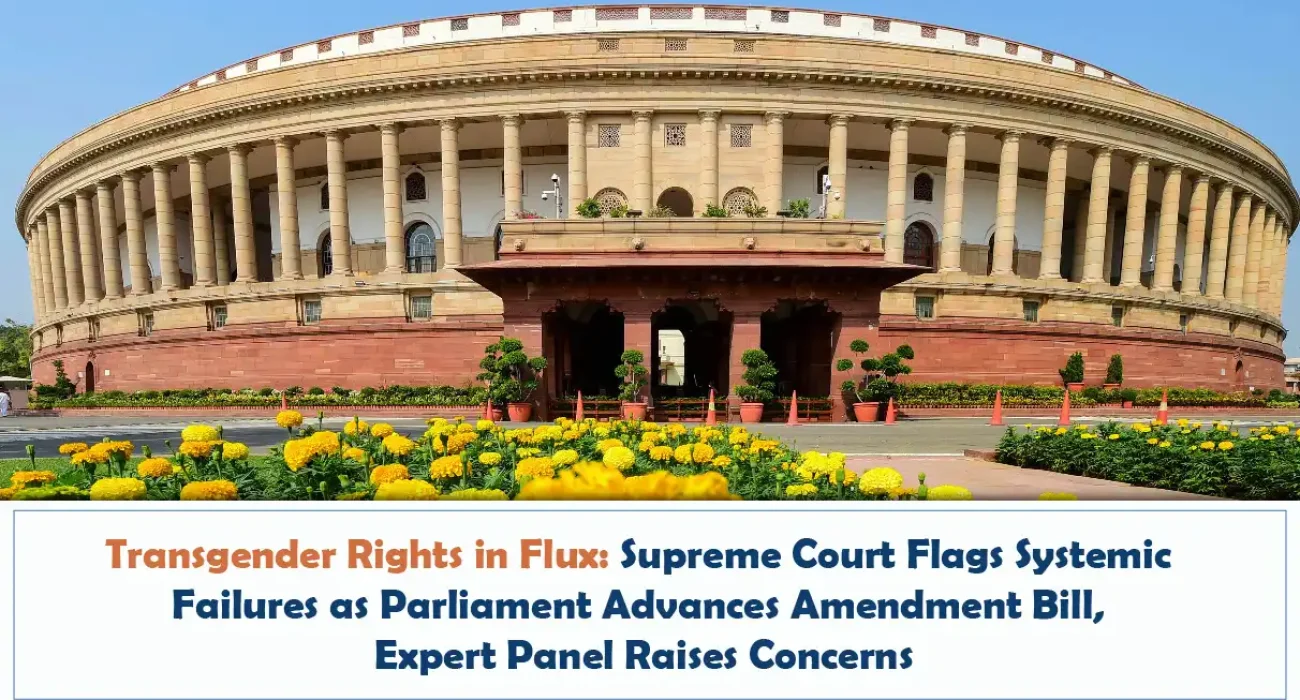
The evolving legal landscape governing transgender rights in India reflects a complex interplay between judicial intervention, legislative reform, and policy critique. The recent Supreme Court judgment in Jane Kaushik v. Union of India, coupled with the passage of the Transgender Persons (Amendment) Bill, 2026, and concerns raised by a Supreme Court-appointed panel, highlights a critical moment of transition—and tension—in India’s approach to transgender rights.
Judicial Recognition vs Ground Reality
In Jane Kaushik, the Supreme Court acknowledged a stark gap between formal legal recognition and lived realities of transgender persons. Despite landmark rulings like NALSA v. Union of India and the enactment of the Transgender Persons (Protection of Rights) Act, 2019, the Court observed that these rights have often remained an empty formality. The case arose from allegations of discrimination in employment faced by a transgender woman, exposing systemic issues such as workplace harassment, lack of grievance redressal mechanisms, and administrative inaction by State authorities. The Court emphasized that non-implementation of statutory protections has effectively denied transgender persons meaningful access to equality, dignity, and livelihood.
From Formal Equality to Substantive Equality
A key contribution of the judgment lies in its articulation of substantive equality. The Court clarified that equality under Articles 14, 15, and 21 is not merely formal but requires positive obligations, including reasonable accommodation, active State intervention, and enforcement of anti-discrimination norms in both public and private sectors. Importantly, the Court extended these obligations to private actors, recognizing the horizontal application of fundamental rights in cases of discrimination. The judgment also strongly criticised administrative lethargy of both Union and State governments, noting that essential mechanisms remain either unimplemented or ineffective.
Legislative Developments: The 2026 Amendment Bill
Amidst this judicial scrutiny, Parliament has passed the Transgender Persons (Amendment) Bill, 2026, marking a significant legislative development. The Bill aims to amend the 2019 Act to streamline implementation and governance mechanisms. However, the legislative process has not been without controversy, with reports indicating that the Bill was passed amid opposition concerns and political disagreement.
Panel Critique: Threat to Self-Determination?
A Supreme Court-appointed panel has raised serious objections to the Amendment Bill, particularly regarding its potential impact on the right to gender self-determination—a core principle recognized in NALSA. According to the panel’s findings, certain provisions of the Bill may dilute the autonomy of transgender persons, reintroduce bureaucratic controls, and undermine the progressive framework established by judicial precedents. The panel has reportedly recommended that the Centre withdraw or reconsider the Bill in its present form.
Tension Between Judiciary and Legislature
The current scenario reveals a three-way tension between the judiciary, legislature, and policy oversight bodies. While the judiciary is expanding rights through substantive equality and accountability, the legislature is attempting reform but facing criticism for potential regression. At the same time, oversight bodies are flagging risks to fundamental rights. This creates a complex legal and policy landscape for transgender rights in India.
Conclusion
The intersection of the Jane Kaushik judgment, the 2026 Amendment Bill, and the panel’s critique underscores a pivotal moment in India’s transgender rights jurisprudence. The Supreme Court has emphasized that legal recognition without implementation is meaningless and that equality must be substantive and enforceable. At the same time, concerns surrounding the Amendment Bill highlight the need for careful legislative alignment with constitutional principles, particularly the right to dignity and self-determination. The future of transgender rights in India will depend on how effectively these competing developments are reconciled.
Written by Adv. K. Sri Hamsa