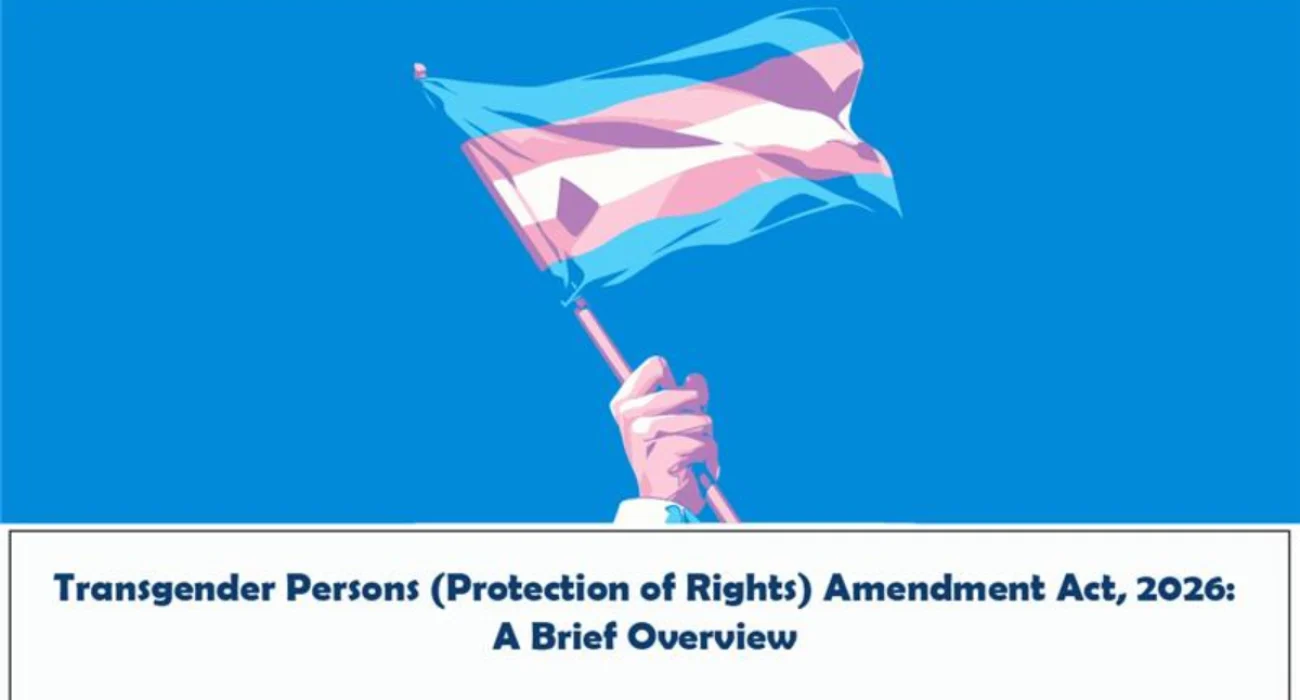
The Transgender Persons (Protection of Rights) Amendment Act, 2026 marks a significant shift in India’s legal framework on transgender rights, modifying key aspects of the Transgender Persons (Protection of Rights) Act, 2019. While the amendment seeks to introduce greater regulatory clarity and stronger enforcement mechanisms, it has generated considerable debate due to its departure from earlier rights-based principles.
A central change introduced by the amendment is the narrowing of the definition of “transgender person.” Unlike the 2019 framework, which adopted a broad and inclusive understanding of gender identity, the 2026 amendment places emphasis on specific socio-cultural identities and intersex variations, while excluding self-perceived gender identities. This has been widely viewed as restricting the scope of legal recognition.
Another key development is the introduction of a mandatory medical certification process for legal recognition. The earlier system involving certification through the District Magistrate has been replaced with approval by a medical board. This represents a clear shift from self-identification to institutional verification, thereby increasing State and medical control over gender identity.
The amendment also introduces enhanced regulatory provisions in healthcare, including obligations on medical institutions in cases involving gender-affirming procedures. Additionally, certain penal provisions have been strengthened, particularly in relation to coercion, trafficking, and forced induction.
However, the amendment has faced significant criticism. The most prominent concern is the dilution of the right to self-identification, recognised as part of the fundamental right to dignity and personal autonomy in NALSA v. Union of India. Critics further argue that the restricted definition excludes segments of the transgender community, thereby weakening the protective scope of the law. Concerns have also been raised regarding privacy and bodily autonomy, given the involvement of medical boards and reporting obligations.
Importantly, the Rajasthan High Court, while dealing with challenges arising from the amendment, has expressed serious reservations regarding its compatibility with constitutional principles. The Court observed that subjecting gender identity to medical certification may be inconsistent with the right to self-determination and dignity and emphasised that identity cannot be reduced to a matter of clinical assessment. It further underscored the need for the State to align legislative measures with the constitutional framework laid down in NALSA, particularly the recognition of gender identity as an aspect of personal autonomy.
In conclusion, the Transgender Persons (Protection of Rights) Amendment Act, 2026 reflects a move towards a more regulated framework of recognition. However, the narrowing of definitions, increased institutional control, and judicial concerns highlighted by the Rajasthan High Court indicate that the law remains contested in its alignment with constitutional guarantees of equality, dignity, and self-determination.
Written by Adv. K. Sri Hamsa