Factual Background:
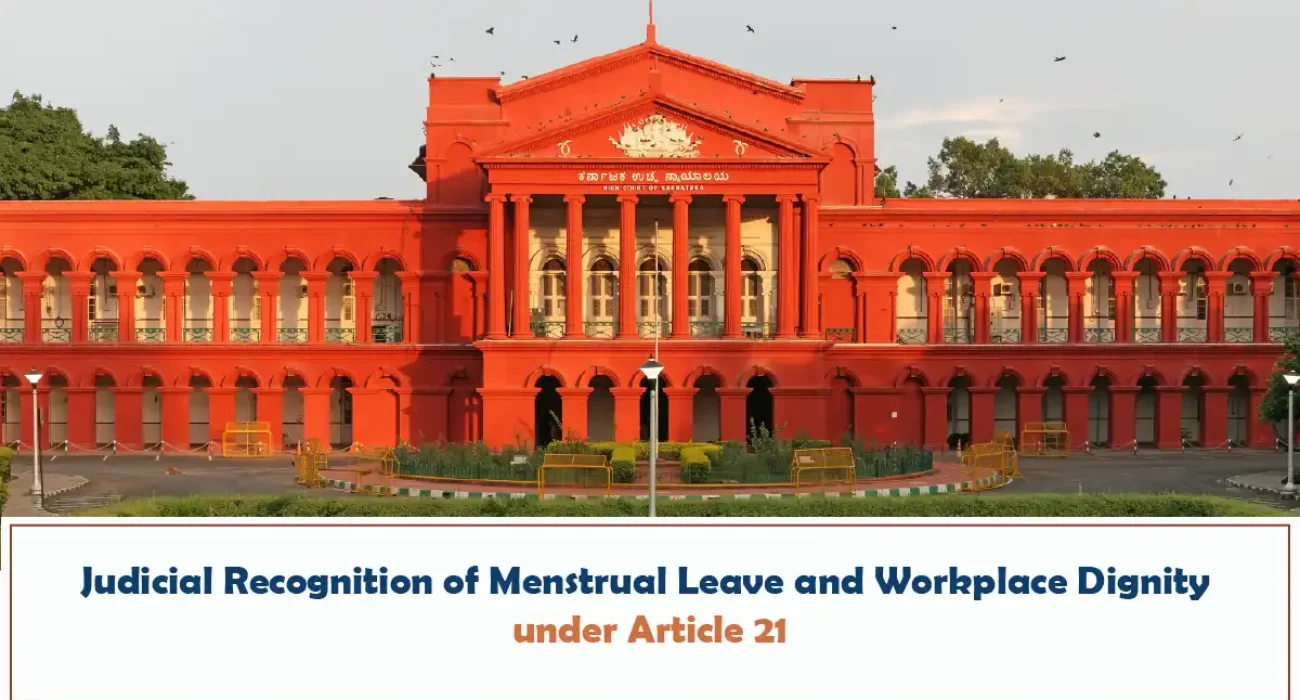
The petitioner, a 41-year-old woman employed as a hotel worker in a small establishment in Belagavi district, approached the High Court under Articles 226 and 227 of the Constitution. She belongs to the unorganized labour sector and performs physically demanding tasks such as cleaning, washing utensils, and serving food for long hours under inadequate and unhygienic working conditions.
She contended that these working conditions become significantly more burdensome during menstruation, when women experience physical discomfort, fatigue, and pain. Despite these realities, women workers in informal sectors are often compelled to continue strenuous labour without any institutional support or relief.
The Government of Karnataka had, after a consultative and expert-driven process, introduced a Menstrual Leave Policy (2025) through a notification dated 12.11.2025 and a Government Order dated 20.11.2025. The policy provided for one day of paid leave per month (up to 12 days annually) for women employees across various sectors, including factories, shops, commercial establishments, and other registered institutions.
However, the petitioner argued that the policy remained largely ineffective in practice, particularly in small establishments and the unorganized sector, where awareness was minimal and enforcement mechanisms were weak.
Accordingly, she sought:
- A writ directing the State to consider her representation regarding implementation;
- A writ of mandamus to enforce the menstrual leave policy uniformly across all establishments, including informal sectors;
- Directions to frame guidelines, circulars, and enforcement mechanisms to ensure effective implementation, especially for vulnerable women workers.
Court’s Analysis:
The Court undertook an extensive examination of the issue from constitutional, historical, social, and policy perspectives, going beyond a narrow adjudication of the petitioner’s grievance.
1. Evolution of Menstrual Leave and Policy Framework:
The Court traced the development of menstrual leave policies historically and globally. It noted early progressive practices such as menstrual leave for students in Kerala (1912), statutory recognition in Japan (1947), and similar initiatives in Bihar for government employees.
It further examined the Karnataka Government’s consultative process, which included inputs from labour unions, employers, medical experts, and women’s organizations. The majority of stakeholders supported the policy, recognizing menstrual leave as a measure of workplace equity, health, and dignity.
2. Constitutional Dimensions – Dignity, Equality, and Privacy:
A significant portion of the judgment is devoted to constitutional principles:
- The Court emphasized that menstrual health is an integral component of the right to life under Article 21, particularly the right to live with dignity.
- It relied on recent Supreme Court jurisprudence affirming that dignity includes protection from humiliation, exclusion, and avoidable suffering.
- The Court also linked menstrual health to bodily autonomy and privacy, holding that forcing women to work under distressing conditions without accommodation undermines decisional autonomy.
Further, the Court acknowledged that the absence of supportive measures can lead to systemic inequality, disproportionately affecting women in physically intensive and low-income occupations.
3. Mental Health and Social Impact:
Importantly, the Court recognized that menstruation-related stigma, social exclusion, and lack of workplace accommodation can adversely affect mental health.
Drawing from prior judicial observations, it noted that:
- Social taboos and discriminatory practices create feelings of inadequacy and exclusion;
- Lack of awareness and hygiene facilities contributes to stress and psychological discomfort;
- Workplace insensitivity can reinforce gender inequality and emotional distress.
Thus, menstrual leave was viewed not merely as a labour welfare measure, but as a holistic intervention addressing physical, psychological, and social well-being.
4. Practical Challenges in Implementation:
While acknowledging the progressive nature of the policy, the Court also recognized practical difficulties:
- Enforcement in the unorganized sector, which lacks formal regulatory oversight;
- Risk of stigma or discrimination by employers;
- Concerns regarding misuse or unintended workplace bias;
- Administrative challenges in monitoring compliance across diverse establishments.
The State also submitted that legislative processes were ongoing (through the Karnataka Menstrual Leave and Hygiene Bill, 2025), indicating that the issue was still evolving at the policy level.
5. Role of the Judiciary:
The Court clarified that while it cannot legislate or enforce policy in absolute terms, it can issue directions to ensure that existing policies are not rendered ineffective due to administrative inaction.
It emphasized the need for:
- Awareness and sensitization among employers and employees;
- Dissemination of policy benefits;
- A balanced approach that promotes welfare without reinforcing stereotypes.
Order of the Court:
The Court disposed of the petition with the following directions:
- The respondents were directed to consider the petitioner’s representation in a time-bound manner.
- The State was encouraged to take steps toward effective dissemination, awareness, and sensitization regarding the menstrual leave policy.
- Authorities were expected to work toward practical implementation, particularly in sectors where women workers are most vulnerable.
- The Court refrained from issuing a blanket enforcement order, recognizing that policy implementation and expansion fall within the executive and legislative domain.
Key Takeaway:
This judgment is a significant step in recognizing menstrual health as a constitutional issue linked to dignity, equality, and mental well-being. It underscores that merely formulating progressive policies is insufficient unless accompanied by effective implementation, awareness, and inclusivity, particularly in the unorganized sector.
The case highlights the judiciary’s role in nudging the State toward substantive gender justice, while also acknowledging practical limitations in enforcement. It ultimately positions menstrual leave as not just a labour right, but a human dignity and mental health concern, requiring systemic and sustained policy action.
Written by Adv. K. Sri Hamsa