

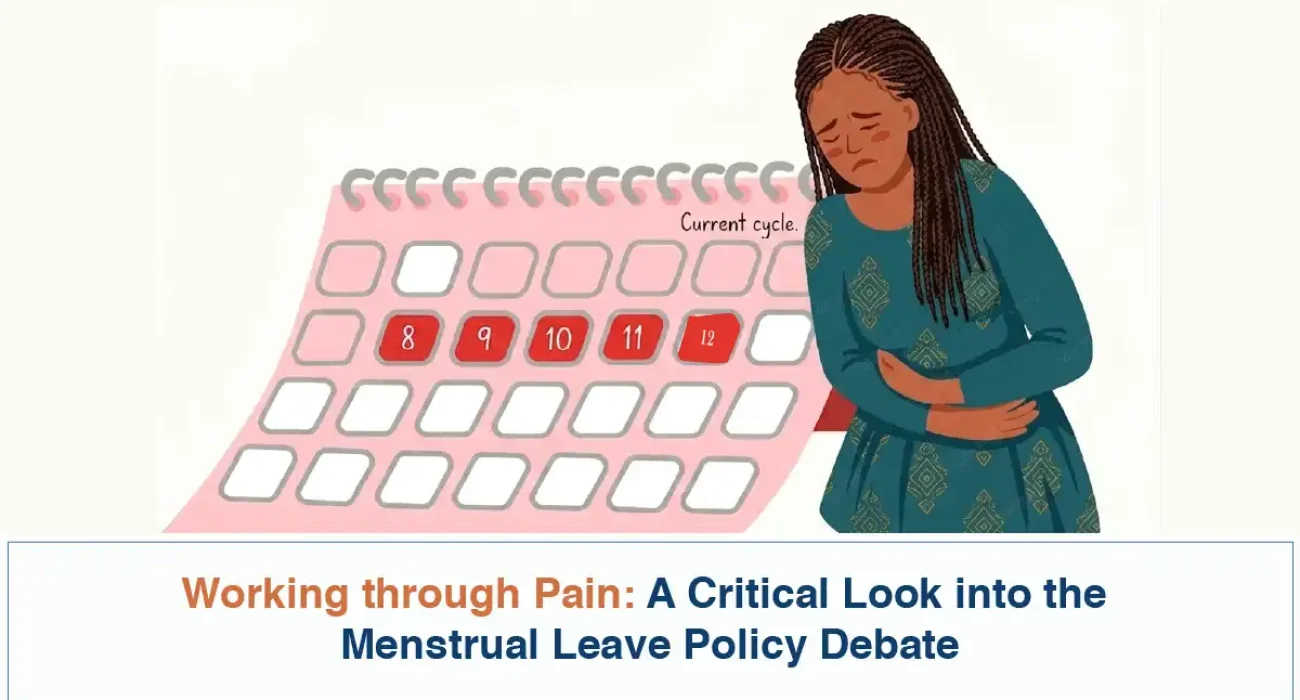
On 13th March 2026, the Supreme Court disposed of a Public Interest Litigation seeking mandatory menstrual leave for women in the workplace. While declining to issue a positive mandamus, the Court expressed concern that making menstrual leave compulsory could have unintended consequences, wherein “nobody will want to hire women” or assign them significant responsibilities.
The Court’s concern is not entirely without basis, since workplace bias is real, and gender-specific protections have been historically known to be utilized by employers to justify discriminatory hiring practices. i
The more nuanced question, however, is whether the possibility of such bias should prevent the law and workplaces from engaging seriously with menstruation as a health, dignity and equality issue. To engage fully with the legal debate, it is necessary to understand and acknowledge the larger social, personal and health-related context in which the demand for menstrual leave arises.
To understand how menstruation affects everyday life at work, and what meaningful support could look like, we at Equilibrio Advisory conducted a short workplace survey with folx who experience menstruation. The survey was conducted with the understanding that conversations surrounding menstrual leave and workplace support cannot be shaped in abstraction.
Participants were invited to respond to the following questions:
Policies concerning menstruation must necessarily engage with lived realities, particularly because menstrual experiences are deeply varied and often shaped by institutional silence, widespread stigma, and limited access to support. This article therefore places the legal and policy debate alongside the survey findings, while also interspersing anonymised excerpts from participants’ responses to foreground lived experience.
Before turning to the debate surrounding menstrual leave, it is essential to first understand what such policies ordinarily involve, and how they have developed across jurisdictions.
Menstrual Leave Policy, simply understood allows employees to take leave or access flexibility when menstruation-related symptoms impair their ability to work. Typically, these policies allow employees to take time off or access flexibility as required. However, there is no single universal model of menstrual leave across jurisdictions. Policies vary in terms of the number of days granted, whether the leave is paid or unpaid, whether it is treated separately or as part of sick leave, and whether any procedural requirements or medical certification are imposed.
The history of menstrual leave is often traced to labour movements in the early twentieth century. Soviet Russia introduced protective labour measures for menstruating workers in the 1920s, while Japan’s menstrual leave framework emerged from labour union demands and was later incorporated into its labour law framework in 1947. Since then, countries such as Japan, South Korea, Indonesia, Taiwan, Zambia and Spain have adopted different forms of menstrual leave or menstrual-health-related workplace protections.
In the Indian context, there is no central provision for menstrual leave. However, certain states and private employers have introduced menstrual leave or menstrual support policies in different forms. Bihar, for instance, has allowed two days of menstrual leave per month for women government employees since 1992. Kerala has extended menstrual leave and attendance relaxation to female students in universities and higher education institutions (2023). Odisha has also introduced one day of additional leave per month for eligible women employees since 2024. The Karnataka government introduced a menstrual leave policy (2025) granting women employees one day of paid menstrual leave per month, total 12 days annually, with no medical certificate required. In the private sector, companies such as Zomato, Swiggy and BYJU’S have adopted voluntary menstrual leave policies.
Indian courts have also increasingly engaged with menstrual health through the lens of dignity, equality and access. In Dr. Jaya Thakur v. Union of India (2026), the Supreme Court recognised menstrual hygiene management as linked to dignity, equality and the right to education, observing that lack of menstrual health infrastructure can convert a biological reality into a structural barrier.
Recently, in Chandravva Hanamant Gokavi v. State of Karnataka (2026),the Karnataka High Court directed strict implementation of Karnataka’s Menstrual Leave Policy notified last year. The Court located menstrual leave within the constitutional framework of right to dignity, health, privacy, bodily autonomy and substantive equality, recognising it as connected to Articles 14, 15(3), 21 and 39(e) of the Constitution.
The existing debate on menstrual leaves:
The debate on menstrual leave is not simply about whether menstruating employees should be granted additional leave. It also raises deeper questions about workplace equality, gendered assumptions, and the kind of worker around whom professional spaces are designed.
One concern often raised is whether recognising menstrual leave may unintentionally reinforce the idea that women are not “at par” with men, or that menstruating employees are less capable of performing consistently at work. While there is some merit to the argument that a carelessly framed menstrual leave policy may strengthen the very stereotypes it seeks to address, the answer cannot be to deny or trivialise the issue altogether, while menstruating employees continue to suffer in silence.
“The truth is that around the world, women continue to be disadvantaged by a working culture that is based on the ideological belief that male needs are universal.”
~ Caroline Criado Perez, “Invisible Women: Data Bias in a World Designed for Men”
Caroline Criado Perez in “Invisible Women: Data Bias in a World Designed for Men” writes, “The truth is that around the world, women continue to be disadvantaged by a working culture that is based on the ideological belief that male needs are universal.”
Building inclusive workplaces, therefore, requires more than a formal commitment to equality. It requires recognising that employees may need different forms of support in order to participate on equal terms. The question is not whether menstrual leave makes women less capable. The question is whether workplaces have been designed in a way that requires menstruating employees to absorb certain burdens privately in order to appear equally capable.
To assess the issue properly, it is necessary to move away from menstrual leave as an abstract policy issue and look more closely at the experiences surrounding menstruation itself.
| Indicator | Figure | Source |
| People who menstruate globally (per month) | 1.8 billion | UNICEF |
| Global population of reproductive age | 26% | UNICEF; corroborated by Frontiers Journal & PMC |
| Women & girls who menstruate in India | 355 million (35.5 crore) | Times of India, 2024 |
| India’s menstruating population as share of total population | 27% | Times of India, 2024 |
| People globally lacking access to menstrual hygiene facilities | 500 million | UNICEF |
| Girls in India with no knowledge of menstruation before first period | 71% | UNICEF India |
| India’s menstruating women using sanitary protection | 36% | Save the Child / Scroll.in |
Table 1: Understanding the social landscape of menstruation
Menstruation is not a marginal experience According to UNICEF, around 1.8 billion people across the world menstruate every month, while persons of reproductive age constitute roughly 26 percent of the global population. In India, approximately 35.5 crore women and girls menstruate, representing around 27 percent of the country’s population. (Times of India, 2024)
These figures are particularly significant in the workplace context because the age range during which people menstruate substantially overlaps with their working years. This underscores the need for inclusive workplaces that suitably account for employees’ menstrual health needs, instead of treating menstruation as an invisible or private inconvenience.
Historically, menstruation has served as a basis for excluding women from social, religious and public life. Even today discussions surrounding menstruation are often shrouded in secrecy, and associated with connotations of ‘impurity’.
“Since our childhood we are being told continuously to stay in another room when you are in your “Those Days.” For me, it has started from my home, where I was not supposed to touch anything, and sit in a different room until I complete 5 days of “Those Days.”
This stigma is not confined to the cultural context, lack of menstrual hygiene infrastructure has contributed to absenteeism and school dropouts. A report cited by Down To Earth (2015) noted that almost 23 percent of girls drop out of school on reaching puberty, with menstrual hygiene challenges, such as lack of facilities and social stigma playing a significant role. The connection between menstruation, dignity and public participation has already been recognised by the Supreme Court in the educational context. In January 2026, the Court recognised access to menstrual hygiene management in schools as linked to dignity, equality and the right to education, noting that lack of menstrual health facilities can convert a biological reality into a structural barrier (Dr. Jaya Thakur vs Union of India)
The symptoms of menstruation can be varied and diverse. A study by Shabnam Omidvar et al., conducted among 1,000 Indian female students aged 11–28, found that 70.2 percent of participants experienced dysmenorrhea, or painful periods. According to the study, common symptoms of menstruation included tiredness, back pain, mood swings, headaches and cramps, affecting both physical and emotional wellbeing. Menstruation is not experienced uniformly. For some, it may involve manageable discomfort. For others, it may involve severe cramps, heavy bleeding, fatigue, headaches, back and leg pain, dizziness, nausea, mood changes, anxiety, irritability, and difficulty concentrating or sitting for long hours. These experiences may also be compounded by underlying conditions such as PMOS, endometriosis, PMDD, fibroids, or other hormonal and reproductive health concerns, which can make menstrual symptoms more severe, unpredictable or difficult to manage.
The workplace survey received responses from 14 participants, across varied age groups, residing and working in cities across India. While the survey was not intended to be a representative study, it was designed to capture the lived experiences surrounding menstruation at the workplace.
When participants were asked how menstruation affects their everyday professional lives, the responses did not point to one single experience. They reflected a range of physical, emotional and workplace-related difficulties.
“It’s not just about ‘having a bad day’; it’s about feeling like you are fighting your own body while still being expected to function normally.”
Participants to the survey reported a range of physical and emotional symptoms, including:
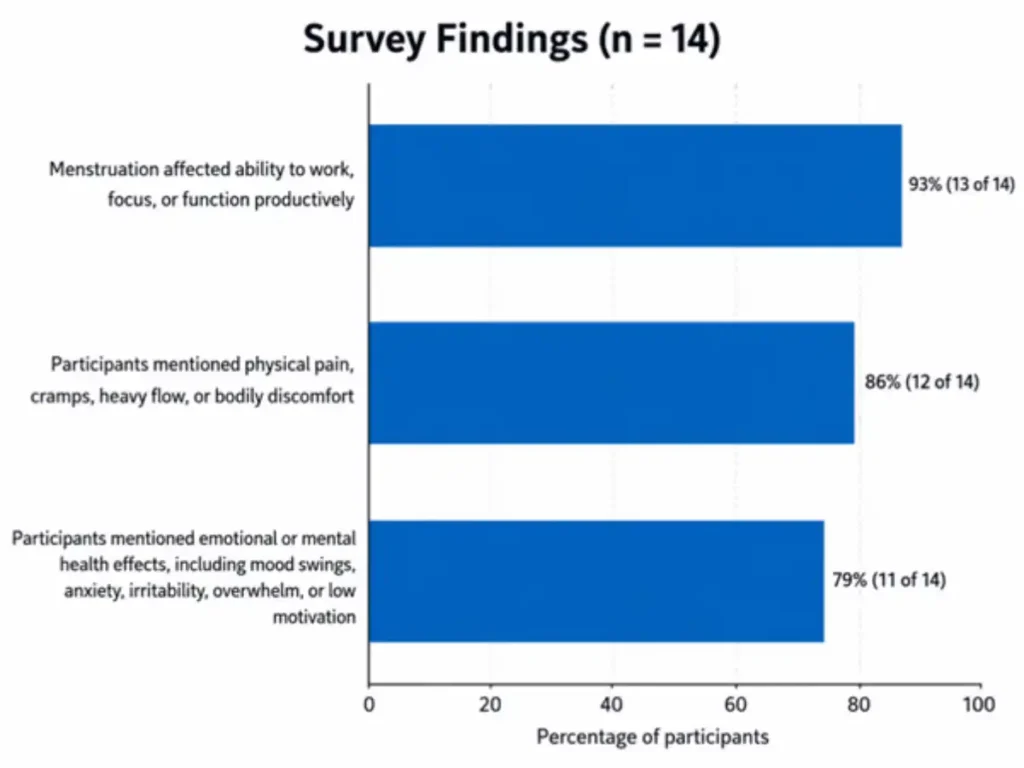
From the survey, 93% of participants indicated that menstruation affected their ability to work, focus, or function productively. 86% of participants referred to physical pain, cramps, heavy flow, or bodily discomfort, while 79% referred to emotional or mental health effects, including mood swings, anxiety, irritability, overwhelm, or low motivation.
Impact on Productivity
At an individual level, menstruation-related symptoms can affect both physical well-being and emotional experience.
“Tasks that I would usually complete efficiently tend to take longer, and maintaining concentration becomes more challenging.”
At the organisational level, the impact of menstruation-related symptoms is often discussed through the concepts of absenteeism and presenteeism. Absenteeism is generally used to refer to time away from work, while presenteeism refers to being physically present at work but functioning at reduced capacity because of pain, discomfort or fatigue.
However, in the context of menstruation, this language requires some caution. Where an employee takes time off because of severe cramps, heavy bleeding, fatigue or related symptoms, it may be technically counted as absence from work, but it should not automatically be understood as “absenteeism” in a negative or disciplinary sense. It is important to acknowledge in that regard that taking time off may be a necessary health-related response, or precisely the kind of accommodation that allows the employee to recover and return to work with dignity.
A nationwide study in the Netherlands found that menstruation-related symptoms caused significant productivity loss, with presenteeism contributing more than absenteeism. The study recorded an average productivity loss of 33 percent, resulting in a mean of 8.9 days of total lost productivity per year due to presenteeism.
It is therefore important to acknowledge that refusing to recognise menstrual health does not remove its workplace impact. It simply makes that impact invisible and shifts the burden onto employees, who are left to absorb the consequences of managing a normal bodily function within systems that are often not designed with them in mind. This burden becomes especially stark in workplace settings where taking a break, slowing down, or asking for support does not feel like a real option. Recalling a prior experience involving heavy bleeding during a day-long teaching assignment, participant shared:
“I really needed a break that day and I didn’t feel like it was a possibility. You’re made to feel like a weak fool for needing support.” – Participant, Survey by Equilibrio Advisory LLP (2026)
The survey responses suggest that meaningful menstrual support cannot be reduced to a single uniform solution. For some employees, support may mean menstrual leave. For others, it may involve flexible work arrangements, work-from-home options, lighter scheduling during particularly painful days, access to clean washrooms and menstrual products, rest breaks, or simply the ability to communicate discomfort without embarrassment or fear of judgment.
“I think recognising that everyone has a different menstrual cycle is a very supportive aspect from the employer’s end.”
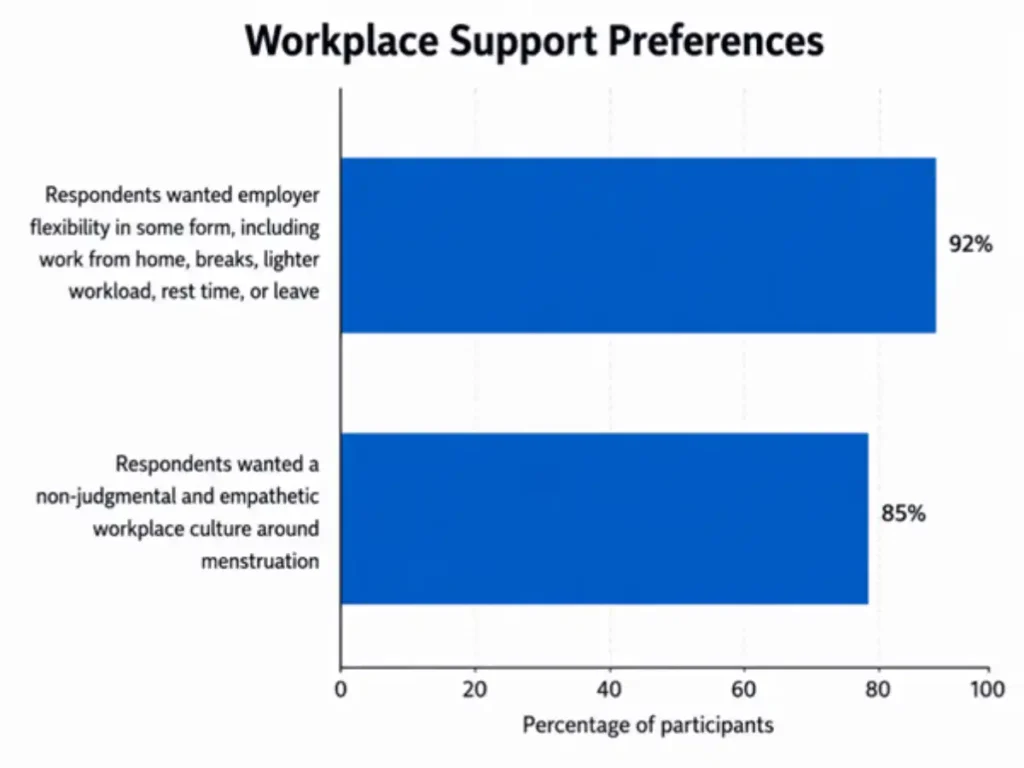
92% of respondents wanted employer flexibility in some form, including work from home, breaks, lighter workload, rest time or leave. 85 percent wanted a non-judgmental and empathetic workplace culture around menstruation.
Menstrual experiences are deeply varied, shaped not only by biology, but also by social conditioning, workplace culture, health conditions, pain thresholds, access to infrastructure, and the stigma attached to speaking openly about menstruation itself. In that sense, any conversation on menstrual leave or menstrual support necessarily requires the participation of those who actually experience it.
Representation becomes particularly important in debates such as these because policies framed without lived experience often risk becoming either overly paternalistic (reproducing existing power structures under a welfare framework) or entirely disconnected from practical reality. The question is not simply whether workplaces should “allow” menstrual support, but what meaningful support actually looks like in everyday professional life. An inclusive policy, therefore, should make it possible for employees to seek support in a manner that is dignified, practical, and free from shame, suspicion, or the fear of being perceived as less capable.
“As a mentor, I would like the women in my team to feel comfortable enough to not work or go easy at the time, as I understand my experience may not be the experience of many women and thresholds for pain, agony and mood swings during this time are subjective” – Participant, Survey by Equilibrio Advisory LLP (2026)
Towards a more Equitable Workplace:
The menstrual leave debate is often pushed into a binary: either menstrual leave must be mandated as a fixed entitlement, or any recognition of menstruation in the workplace will inevitably reinforce stereotypes against women. That framing leaves little room for the more difficult, and perhaps more useful, question of how workplaces can respond to menstruation without being either dismissive or paternalistic.
A more supportive approach would begin by recognising two things at once:
Conversations surrounding menstrual health have historically been marked by silence. Perhaps the first step towards more inclusive workplaces is simply to stop treating menstruation as something that must remain invisible.
We invite readers to share their own experiences surrounding menstruation in professional spaces, and their thoughts on what meaningful workplace support should look like. Your responses will help broaden this conversation and contribute to a more nuanced understanding of menstrual health, dignity and inclusion at work. At Equilibrio Advisory, we work at the intersection of law, mental health, and workplace inclusion, with a focus on building equitable and safe spaces through legal remedies and psychological interventions. For organisations looking to develop meaningful, psychosocially informed and inclusive workplace policies, we would be happy to support this conversation further.
(Anonymised Survey Results): Survey Responses
Written by Adv. Prerna Murarka, reviewed by Rosanna Rodrigues
References: